-
About BHI
About BHI
We report independently on the performance of the NSW healthcare system to inform improvements to care for patients, and enhance transparency and accountability
BLOG
Understanding which survey measures have the strongest influence on overall patient experiences
9 September 2026
 Find out more
-
Reports
Reports
Our reports show where the healthcare system is performing well and where there are opportunities to improve care for patients
Latest report
-
Patient surveys
Patient surveys
Find out what thousands of people have told us about their healthcare experiences in NSW. The results show where public health services are performing well and where they need to improve
Latest survey results
The Insights Series – Emergency department use and experiences for children and young people
Released: 9 September 2026
 Find out more
-
Media
Media
See our latest media releases or get in touch with the team regarding our healthcare performance reports and data
Latest MEDIA RELEASE
New BHI reports provide insights into children's emergency care and NSW public hospital performance
Released: 9 September 2026
 Find out more


Year in Review 2024–25
Our latest Year in Review provides an overview of BHI’s activities and achievements throughout 2024–25.
The report outlines the range of reports we released, survey development, stakeholder engagement and the innovative ways our reports are being used to drive improvements to care.
From the Board Chair and A/Chief Executive


BHI has focused on enhancing the usefulness of our reporting for our stakeholders.
In addition to regular reporting of patient survey results, additional analysis offered insights into why patients visited emergency departments (EDs) rather than other primary care services and what makes a positive difference to patients’ experiences in EDs. We also reported on some of the highest priority areas outlined in Future Health, for example, Aboriginal patient experience, virtual care and sustainable healthcare.
In Healthcare Quarterly, for our special reporting component we tracked record hospital demand in the context of population growth.
We continue to be inspired by local health district (LHD) and specialty network teams demonstrating innovative ways to use BHI reports to improve care. These and other examples prompted us to introduce the new BHI Internal Reports Hub to enhance support for LHDs in accessing and using our information.
We thank our talented and dedicated staff who have delivered exceptional work, with a relentless focus on fairness, accuracy and meaningfulness, while routinely pursuing innovation and efficiency.
We also thank the BHI Board for its guidance and commitment to strengthening transparency and accountability in healthcare.
We acknowledge Dr Diane Watson, who retired in June 2025, for her exceptional contribution to BHI from its inception and her unwavering focus on the power of information to strengthen accountability and inform improvement.
For more information about BHI, visit the Our role page
NSW Patient Survey Program

Overview
BHI surveys are a unique source of statewide patient experience benchmarks and trends that can be used to make fair comparisons between hospitals based on robust, representative results from more than 200 hospitals. Surveying patients some weeks after their health service visit means they can reflect on their care journeys and on important outcomes and experiences since leaving hospital.
Data collection, report production and delivery
BHI implemented more innovative and efficient approaches to the NSW Patient Survey Program including improved sampling methods, new approaches to data collection, and more efficient data processing, report production and release processes.
This allowed BHI to release results up to five months earlier than in previous years to enhance their value to stakeholders.
Survey questionnaire development
BHI continued to include special survey modules to deliver insights into high priority areas for the health system. We reported first-of-their-kind insights into patients’ expectations and views of NSW Health’s efforts to deliver more sustainable health services. This module was developed in collaboration with the NSW Ministry of Health to inform and support NSW Health’s Net Zero Roadmap 2025–2030.
In 2025–26, further insights into experiences outside of hospital and with elective surgery and ambulance services will be sought through survey modules.
Delivering insights
BHI published annual results for three surveys, on emergency department (ED), admitted patient and cancer care, along with an Insights Series report based on five years of patient feedback in the statewide Virtual Care Survey.
In addition to publishing annual results, BHI deployed advanced analytics and drew on linked data sets to deliver deeper insights. In 2024–25, these included the experiences of patients who had elective surgery and factors influencing patients’ experiences in EDs. BHI routinely provides information in regular reporting on the experiences of Aboriginal patients, and comparisons of experiences in rural and urban hospitals.
We also continued to provide researchers with access to survey data to support further analysis and insights. For more detail, see the Data access and research page here.
Results and insights from the NSW Patient Survey Program are used effectively and in a variety of ways across NSW Health to reflect on performance and inform improvements to care. See Case studies: Demonstrating effective use of BHI data here.
Aboriginal patient experience
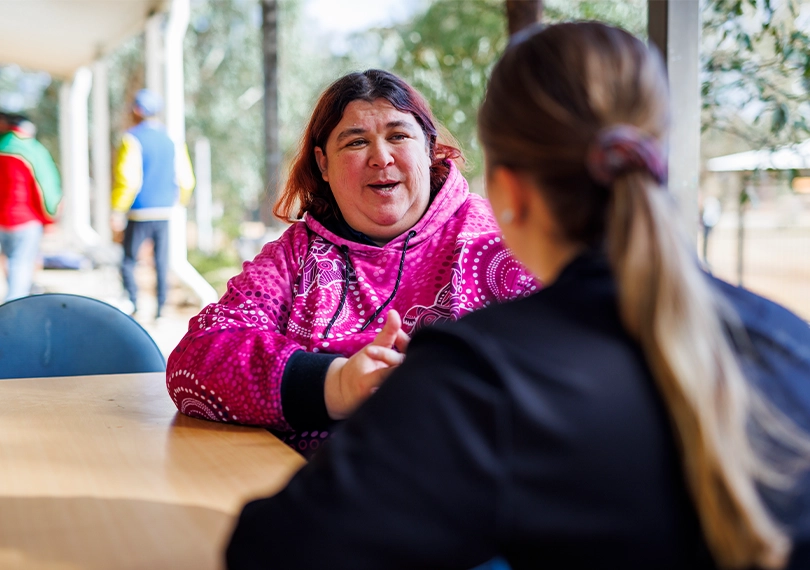
BHI continued its multi-year partnership with the NSW Ministry of Health’s Centre for Aboriginal Health which is focused on inviting Aboriginal people to provide feedback about their experiences of care and reporting the results in meaningful and transparent ways.
Measuring and monitoring the self-reported experiences of hospital care for Aboriginal patients provides unique information about how well the NSW public health system is performing. It provides transparency for the community, as well as information to help policy-makers and health-system managers target improvement efforts.
BHI acknowledges that partnering with Aboriginal people in the collection and use of patient survey data is essential to respecting the right to self-determination. Accordingly, BHI is committed to involving Aboriginal people at each stage of the data lifecycle – from survey design through to reporting and data sharing to the community in line with principles of Indigenous Data Sovereignty.
In 2024–25, BHI implemented a new Aboriginal patient experience index measure for local health districts (LHDs) and delivered the first set of six-monthly scores against the new key performance indicator (KPI) target set by the NSW Ministry of Health. The measure helps monitor LHD performance and inform healthcare improvements for Aboriginal patients. Read more below in Our reports.
BHI continued to provide annual results to LHDs and the NSW Ministry of Health based on Aboriginal patients’ responses to the Adult Admitted Patient Survey (AAPS), which includes a special module of questions for Aboriginal people.
In addition, BHI routinely reported NSW-level Aboriginal patient experience results publicly for admitted and emergency department patients in annual survey results reports and in the BHI Data Portal.
Work began on an Insights Series report, released in late 2025, highlighting the experiences of more than 12,000 Aboriginal patients admitted to NSW public hospitals between 2019 and 2024.
Read more about the Aboriginal Patient Experience Survey Program here.
Our reports
Annual survey results
Adult Admitted Patient Survey 2023
More than 21,000 patients told us about their experiences of care as admitted patients in one of 86 NSW public hospitals from January to December 2023.
Most patients reported positive experiences with the care they received, with ratings for most questions stable or slightly improved compared with 2022 at NSW level and for most LHDs. The largest improvements were in patients’ ratings of health professionals, involvement in decision-making and timely and coordinated care.
The report included additional information about the experiences of Aboriginal patients, comparisons of patients’ experiences in large rural and urban hospitals, and comparisons of the experiences of patients who did and did not have surgery during their admission.
Emergency Department Patient Survey 2023–24

More than 21,000 patients told us about their experiences of care in one of 77 emergency departments (EDs) in NSW from July 2023 to June 2024.
The majority of patients were positive about the care they received in NSW EDs, and ratings for most questions improved or remained stable compared with 2022–23. The largest improvements were in patients’ ratings of health professionals and how well they worked together. The report included additional findings which showed almost three in 10 patients who visited EDs in May and June 2024 reported that their condition could have been treated by a GP or other health professional either ‘definitely’ (12%) or ‘to some extent’ (16%).
It also identified factors influencing patients’ experiences in EDs, including waiting time to receive treatment, time spent in the ED and pain management; and compared patients’ experiences in larger rural and urban EDs.
Outpatient Cancer Clinics Survey 2024

This report reflected the experiences of almost 10,000 adult patients who attended one of 44 NSW facilities housing outpatient cancer clinics in February 2024, including three private facilities.
For the first time, patients were invited to provide feedback about their overall journey of care including with the clinic, their general practitioner (GP) and other health services. Reflecting on their journey of cancer care, the majority of patients were positive about the information provided when they were diagnosed and also about their involvement in decision-making about their treatment.
However, around one-third of patients (35%) said they experienced a loss of income or other financial burden related to their cancer diagnosis and, of these, one in five (20%) described the impact as ‘high’.
Healthcare in Focus

The report looked at NSW health system performance across the state on access and wait times; experiences of patients and healthcare staff; and safe care and clinical outcomes. It also highlighted areas where the system is responding and adapting to new challenges.
NSW performance was compared with other Australian states and territories, and comparable countries for selected measures where data were available. The report showed, for example, that NSW performs comparatively well in terms of ED waiting times, and most patients continued to provide positive ratings of their overall care.
It also included new data in relation to mortality within 30 days across NSW public and private hospitals; and patients’ views and expectations in relation to environmental sustainability of their healthcare.
Patients' feedback on environmentally sustainable healthcare services

To inform and support NSW Health’s Net Zero Roadmap 2025–2030, Healthcare in Focus delivered first-of-their-kind insights into patients’ expectations and views of NSW Health’s efforts to deliver services in more environmentally sustainable ways, and their willingness to take actions to support these efforts.
Findings were based on results from BHI’s online survey of more than 1,300 NSW patients discharged from a public hospital in late 2024. The results showed that around nine in 10 patients supported NSW Health and its hospitals providing health services in more environmentally sustainable ways. More than eight in 10 were willing to personally take action on environmental sustainability, with relevant support from health professionals.
Healthcare Quarterly
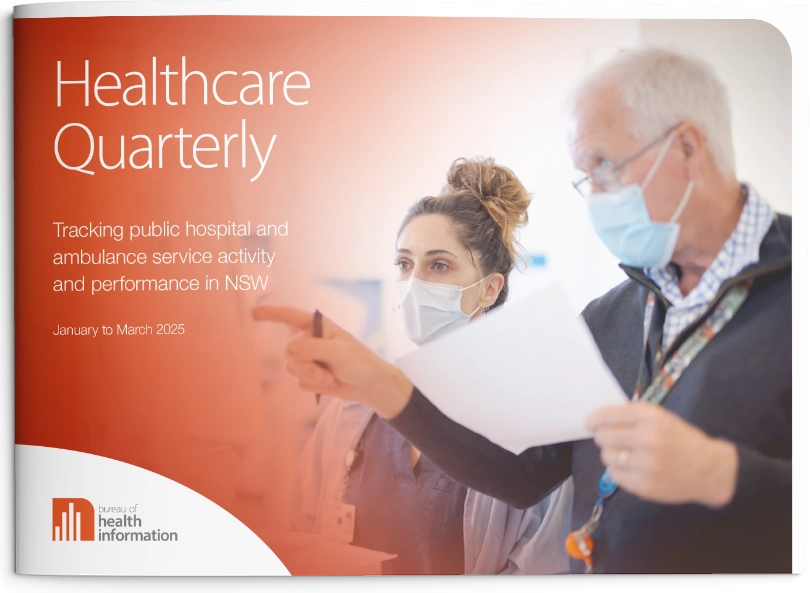
Healthcare Quarterly tracks activity and performance for emergency department (ED), admitted patient, elective surgery and ambulance services in NSW. It also includes reporting on seclusion and restraint in public hospitals with specialised acute mental health units on a six-monthly basis.
BHI provided additional insights on the context and drivers for activity and performance through Special Reporting sections, including about patients who left the ED without, or before completing, treatment, and how health system activity has changed over time relative to NSW population growth.
The reports continued to include breakdowns of activity and performance for key measures in rural and urban areas.
Updated reporting based on new emergency department access targets and ambulance response grid
BHI responded to evolving system priorities following NSW Health’s introduction of new Hospital Access Targets (HATs) for local health districts (LHDs) relating to the time from arrival to leaving the ED, and NSW Ambulance’s transition to a new clinical response grid which streamlined the number of emergency response categories.
Both changes required major updates across key Healthcare Quarterly report products, including the main report and digital tools including the BHI Data Portal and Activity and performance profiles.
In the case of the mid-quarter transition to the new clinical response grid, which resulted in major limitations on reporting for the January to March 2025 quarter, BHI implemented a range of temporary measures to ensure meaningful reporting that continued to provide transparency to the community.
By the April to June 2025 quarter, full reporting across ED and ambulance services had been fully restored, providing new and valuable insights about system performance and patients’ experiences.
The Insights Series
Patients’ experiences of safe care and readmission to hospitals over time

This report provided insights into more than 115,000 patients’ NSW public hospital experiences in areas that relate directly to safety and risk of unplanned readmission following hospitalisation. The report included clear signposting to help readers understand what made individual survey measures important.
BHI’s analyses examined experiences of care for patients admitted to NSW public hospitals between 2018 and 2023, including trends over time at NSW and local health district (LHD) level.
Additionally, the report included NSW-level trends in readmissions for patients admitted to public hospitals between 2016 and 2022, showing a reduction in readmission over time.
Patients’ experiences of hospital care over time
This report provided insights into patients’ experiences of care in three areas of high priority to the NSW health system: kind and compassionate care; effective communication and information; and discharge planning.
The findings were based on what more than 200,000 people told us about their experiences as admitted or ED patients in NSW public hospitals between 2018 and 2023.
The report also highlighted where ratings of care for LHDs and specialty networks significantly improved or declined over time and where results have been consistently higher or lower over the period.
Patients’ experiences of virtual care with NSW public hospital outpatient clinics

This report provided insights into more than 12,000 patients’ experiences of virtual care services with NSW public hospital outpatient clinics and general practitioners (GPs), based on what was learned from five years of feedback in BHI’s statewide Virtual Care Survey (2020 to 2024).
Patients gave consistently high ratings of their virtual care and, over time, they were increasingly likely to say that they would use it again; and that virtual care was ‘better than’ or ‘about the same’ as in-person appointments.
The report also showed that patients were much more likely to have high overall satisfaction with virtual care when they said health professionals worked well together and gave understandable explanations; and their care was well organised.
Measurement Matters
New Aboriginal patient experience key performance indicator for NSW local health districts
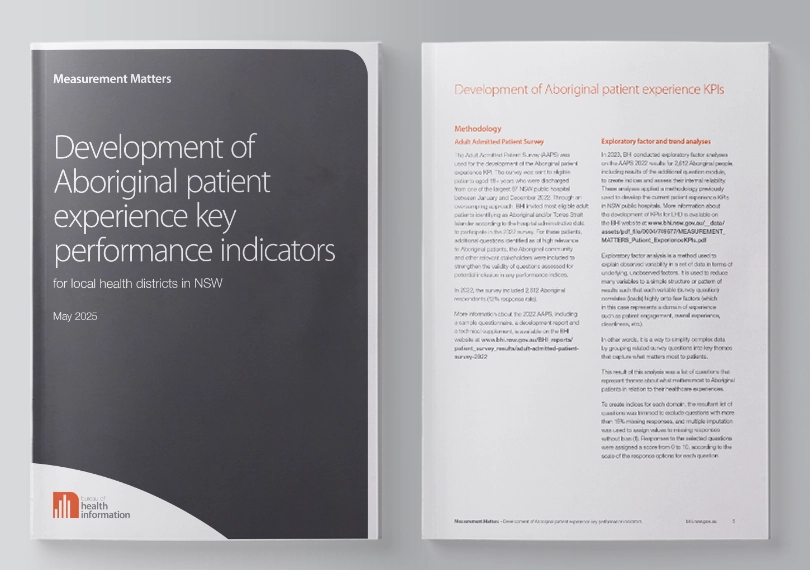
In consultation with the NSW Ministry of Health’s Centre for Aboriginal Health, BHI developed a new Aboriginal patient experience index measure, which supports monitoring of local health district (LHD) performance and informs healthcare improvement efforts for Aboriginal people.
The key performance indicator (KPI) was derived from patient survey data from Aboriginal patients admitted to NSW public hospitals between 2019 and 2022. BHI developed and tested four potential indices of Aboriginal patient experience to establish a measure that was meaningful, reliable and could be used to improve the quality of healthcare services for Aboriginal people.
The first set of six-monthly index scores against the new KPI target set by the Ministry was delivered in 2024–2025.
Internal reporting
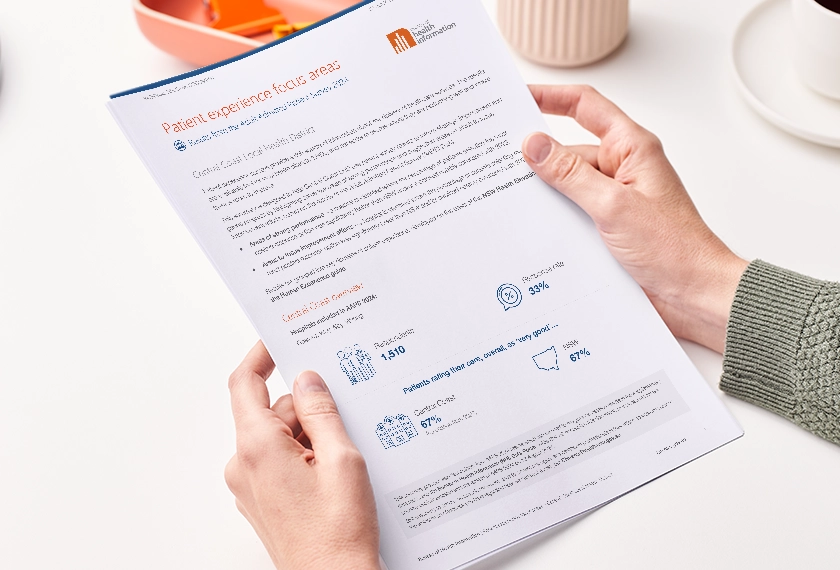
Internal reporting can include information that supplements public reports or information that supports healthcare improvements but is not suitable for public reporting due to factors such as patient privacy.
In 2024–25, this included information drawn from the NSW Patient Survey Program such as patient experience key performance indicators (KPIs) for local health districts (LHDs). At the same time, BHI also provided LHDs with patients’ free-text comments in response to survey questions asking about the best part of their care, and what most needed improving, including for Aboriginal patients.
LHDs were also provided with information about mortality within 30 days of hospitalisation for seven clinical conditions.
To make it easier for LHDs, the NSW Ministry of Health and other NSW Health organisations to access this information in a central location, we launched the BHI Internal Reports Hub in 2024–25. For more details, see Engagement and collaboration here.
Engagement and collaboration
New BHI Internal Reports Hub

BHI made healthcare performance information more accessible to NSW Health stakeholders by delivering internal report products in a single, secure location – the new BHI Internal Reports Hub.
The SharePoint-based Hub provides access to information that, while not publicly reported, is valuable to healthcare professionals and system managers.
The Hub is part of BHI’s efforts to not only make its information more accessible to NSW Health stakeholders, including local health districts (LHDs), but also provide guidance on how to make best use of it.
A Resource section on the Hub includes practical tools, guides and templates to help users navigate and interpret information more effectively.
BHI also onboarded ‘Access managers’ in each LHD who manage the access to information on the Hub in their organisation. BHI will continue to enhance the information and resources available on the Hub, based on ongoing engagement with stakeholders.
Driving awareness and use of BHI reporting
Sharing insights across NSW Health

BHI continued to pursue opportunities to engage with NSW Health system colleagues and beyond to drive awareness of BHI reporting and encourage effective use of the data.
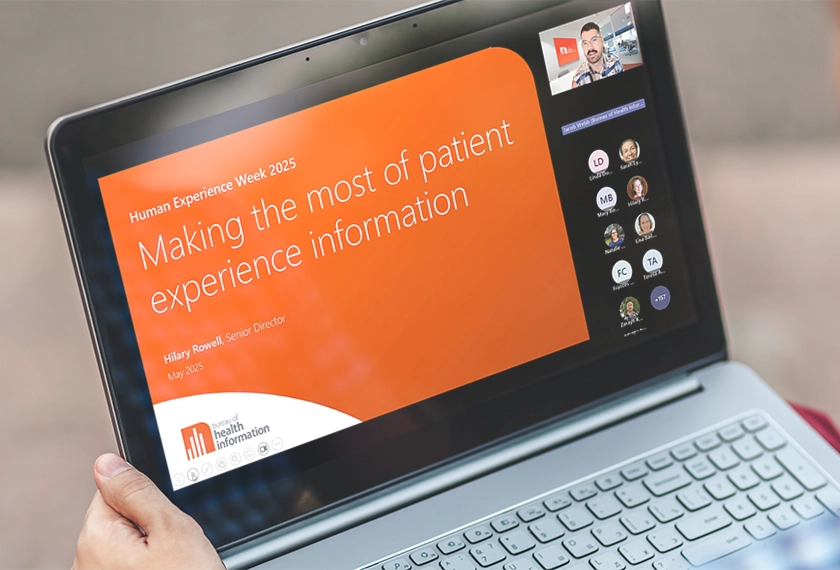
BHI hosted a statewide event for Human eXperience Week 2025, focused on making effective use of patient experience information. The session explored different types of data – including rapid and reflective surveys – and emphasised the importance of turning insights into action. The session was a collaboration with LHD colleagues, who added significant value to the session by demonstrating how they use patient-reported data. There was extensive engagement and enthusiasm from a large audience including during the session and with BHI’s follow-up communications.
BHI delivered presentations at several key conferences during 2024–25, including the Health Services Research Conference, the Patient Reported Measures (PRMs) Symposium and NSW Cancer Summit. BHI also presented at many system committee meetings to help inform action, including Future Health Steering Committees, Self-reported Information Steering Committee, NSW Health Environmental Sustainability Steering Committee, the Elevating the Human Experience Committee and the Virtal Care Monitoring and Evaluation Committee.
The NSW Patient Survey Program Newsletter also continued to receive strong engagement well above industry standards in terms of click rates, communicating key information to NSW Health stakeholders about Program activities and the value of robust, representative survey data.
Supporting system-wide improvements to reporting and data collection
BHI collaborated with colleagues across NSW Health on projects to enhance the value of reporting by aligning with system priorities and improving data collection and quality.
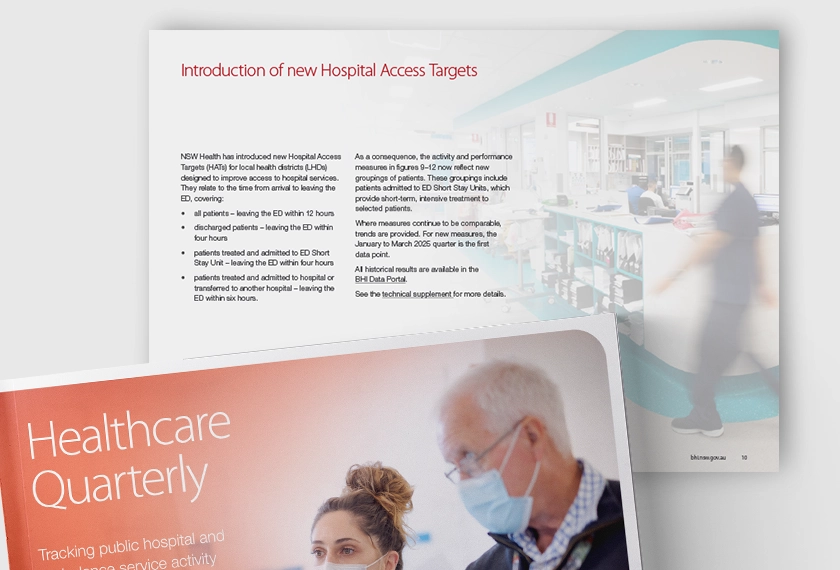
BHI responded to evolving system priorities following NSW Health’s introduction of new Hospital Access Targets (HATs) for local health districts (LHDs) relating to the time from arrival to leaving the ED, and NSW Ambulance’s transition to a new clinical response grid which streamlined the number of emergency response categories.
Both changes required major updates across key Healthcare Quarterly report products, including the main report, and digital tools including the BHI Data Portal and Activity and performance profiles. This provides new and valuable insights about system performance and patients’ experiences.
BHI’s data team also provided extensive support and advice to the NSW Ministry of Health as part of its transition to the new Enterprise Data Warehouse for Analysis, Reporting and Decision (EDWARD). This included identification of data quality issues for resolution to support ongoing, robust public reporting. The extensive work helped ensure a seamless transition in public reporting during the changeover to EDWARD.
BHI has contributed significantly to investigations into strengthening and streamlining the collection of patient experience information across NSW Health. The ongoing work aims to deliver more efficient approaches to seeking patients’ experiences of care across the health system, that reduce the burden on patients and deliver more actionable information to health professionals and system managers.
Empowering researchers to access and use survey data

BHI enabled custom analysis and new insights into patients' experiences by providing researchers with access to 14 NSW Patient Survey Program datasets. Three research articles were published using this data, establishing direct links between patients’ experiences and self-reported outcomes, including hospital-acquired complications, delayed discharge, and readmission to hospitals and emergency departments (EDs).
Several institutes have research projects underway that use BHI data to assist with exploring aspects of patient care and outcomes. For example: The Australian Institute of Health Innovation, Macquarie University is using BHI data to help describe patient-reported experiences for patients receiving care in NSW EDs; and The University of NSW and University of Sydney are working on two separate projects using BHI’s virtual care survey data.
For more details on the use of BHI data in research projects see the Data access and research page here.
Case studies: Demonstrating effective use of BHI data

Enhancing discharge planning
Central Coast Local Health District is using BHI’s patient survey data to redesign discharge planning at Gosford Hospital, aimed at improving patients’ experiences, reducing length of stay and enhancing staff collaboration.
Building data capabilities and safety intelligence
Hunter New England Local Health District is embedding BHI data into governance, communication and safety intelligence frameworks to strengthen its ability to deliver safer, patient-centred care.